
Logistics and heavy transport

High-power charging for heavy fleet without downtime

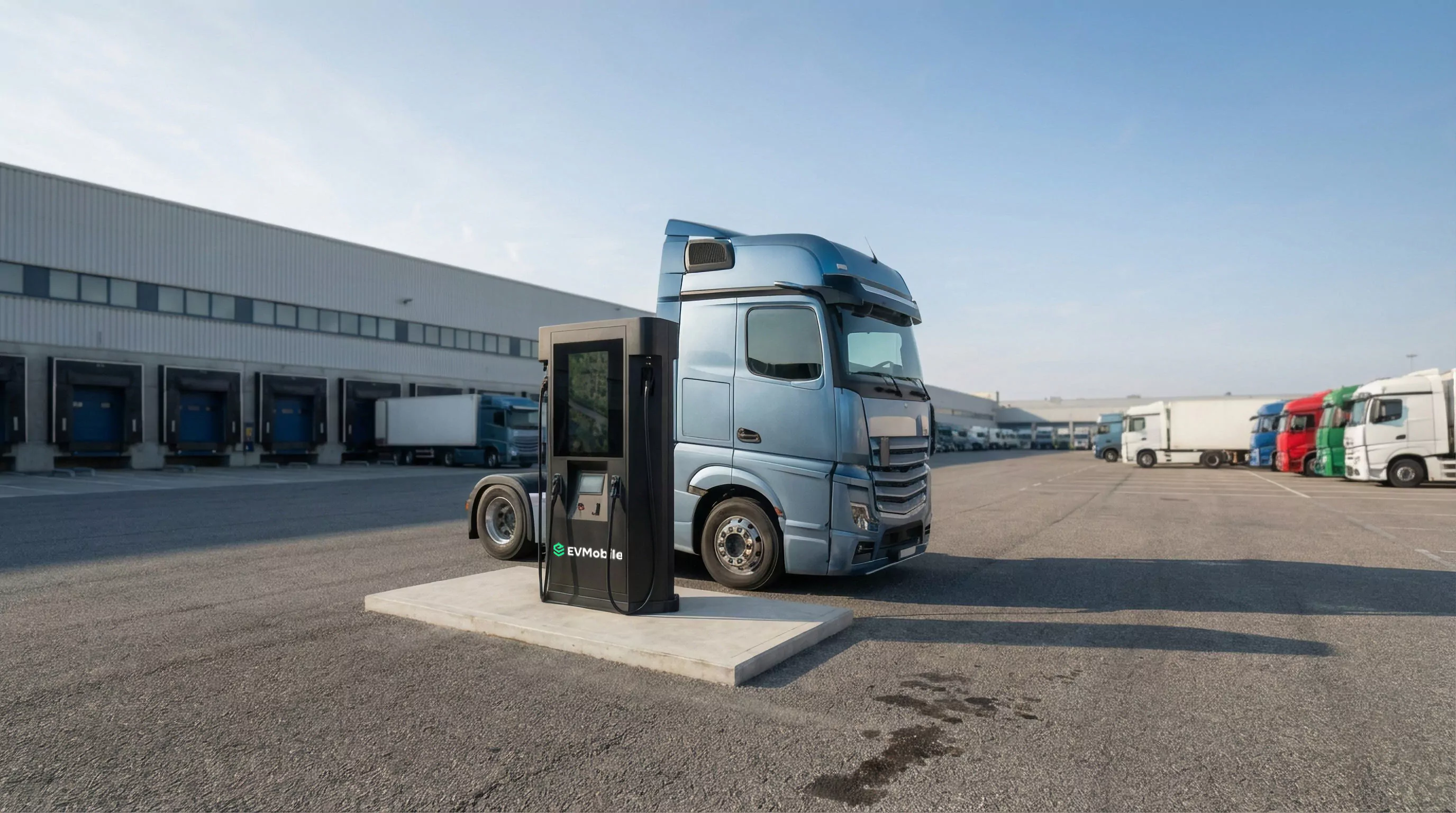
Heavy transport is electrifying fast, and charging must not slow the fleet down. When a heavy vehicle stops to unload, load or take a break, charging has to happen inside that window.

We bring battery-buffered high-power charging to where the fleet is, with no heavy capital investment and no dependence on the grid connection’s momentary capacity.

Beyond the depot

Charging where the fleet stops

Conventionally, heavy transport charging is designed around depots and permanent bases, which makes the charging window narrower than it needs to be. In practice, much of the fleet moves between terminals, worksites, ports and various end points, and never returns to the same place to charge.

EV Mobile brings charging capacity closer to actual use. We size charging power against real dwell time, not against the theoretical capacity of the grid connection.

Charging at the end point

Ports, logistics and distribution centers, warehouse terminals

Overnight charging at the depot

Charging along the route

Rest stops, service areas and fuel stations

Build as you convert

Electrification for changing conditions, without over-sizing

In logistics and heavy transport, charging demand isn’t always predictable. Routes change, schedules tighten, and additional capacity can be needed at short notice.

In the conventional model, charging infrastructure is sized for future peaks. That ties up capital and increases risk when fleet electrification proceeds in stages. With EV Mobile, capacity is built against real use. Cost becomes more predictable and electrification proceeds on a timeline you control.

How buffering works

Battery-buffered high-power charging brings reliability

Battery-buffered high-power charging means the required charging power can be produced without the whole system having to be sized to its extreme at the outset. It enables high charging power even on a limited grid connection, and allows several vehicles to charge simultaneously without capacity spikes.

Charging capacity can also be brought to a site temporarily or during a transition period.

One accountable partner

The right service for the right site

Every site is different. That’s why our solution is designed around vehicle type, dwell time, operating patterns and load peaks.

Under our service model, we take responsibility for the whole system working. When the system is monitored continuously, performance is tracked and maintenance is sized for critical use, technical and operational responsibility doesn’t fall to the customer. It also means lower risk and better fleet utilization.

What we deliver may include

01

Several high-power charge points

02

A battery buffer sized to peak use

03

Continuous monitoring and reporting

04

A service level agreement for critical operation

EU targets

Clear the obstacles to emissions reductions

Electrifying heavy transport is one of the EU’s central emissions reduction objectives. The EU’s targets are to reduce CO₂ emissions from new heavy-duty vehicles by 45% by 2030, 65% by 2035 and 90% by 2040.

45%

by 2030

65%

by 2035

90%

by 2040

At the same time, the AFIR regulation (Alternative Fuels Infrastructure Regulation) requires a comprehensive high-power charging network to be built along the TEN-T transport network (Trans-European Transport Network), with charging stations on main heavy transport routes at intervals of no more than 60–100 kilometers depending on the network section.

Building and expanding the required charging infrastructure moves faster with us. With EV Mobile alongside you, slow-moving projects and permitting processes won’t hold you back. You get the energy solutions you need, quickly.

Looking for a partner who understands your situation?